Frequently Asked Questions about study in UK| VR Education Services

Frequently asked questions for study in UK

As we have already discussed the benefits of studying in the UK institutes and colleges in one of our blogs, now we are here to discuss the frequently asked questions or some common questions that every International student has on his mind while applying for the UK universities or colleges.

Some Frequently Asked Questions About Study in the UK

Q1: Is it possible to study in the United Kingdom without taking the IELTS exam?

Ans. A student can get into any institution in the UK based on their English grades in 12th grade, and some universities also accept applications based on MOI.

Q2. What are the requirements to study in the UK?

Ans. A student can have admission if they are fulfilling any of the below criteria:

1) MOI

2) More in 65 marks in English in 12th Standard

3) IELTS

Even UK allows a gap of up to 10 years to study master’s program.

Q3 How much does it cost to study in the United Kingdom?

Ans. Undergraduate and graduate degrees typically cost between £11,000 and £15,000. They also allow you to pay about 10%of the fees before you get your visa, and the remainder can be paid once you arrive in the UK during the enrolment process. The cost of living varies from £400 to £900 a month, depending on the location and lifestyle.

Q4. What is CAS?

Ans. (CAS) is the acronym for Confirmation of Acceptance for Studies. According to UK immigration requirements, the university must support your student visa application. To apply for a visa to study in the United Kingdom, you’ll need a CAS number. If you wish to study in the United Kingdom, the Confirmation of Acceptance for Studies (CAS) is a crucial document. The institution will also send a unique reference number that will match up with your CAS and it should be mention on the Tier 4 visa application form.

Q5. Can students earn while studying in the UK?

All students with Tier 4 visas are allowed to work for 20 hours per week during an ongoing session and full-time during vacations. Doctorate students can work full-time throughout the year.

Q6. What are the accommodation options available in the UK?

A student can opt for an on-campus residence facility or for off-campus accommodation. If anyone is unable to find accommodation or wish to stay alone, get a space for rent or can stay with families offering homestay facilities. Our VR counselor will also help you find accommodation that works out the best for you.

Q7. Are scholarships are available in Uk?

Ans Yes, almost every university offers scholarships to international students.

Q8.How many months old fund is required for applying for CAS?
Ans. 28 Days old fund is required to apply for CAS from any institute.

Q9. Is it hard to get a UK student visa?

Ans. Multiple factors are involved when it comes to applying for & obtaining a student visa for the UK. Our immigration team is expert in handling student cases especially as we have an Ex Entry Clearance Officer/Visa Officer from the British High Commission in our team.

Q10. Is the UK a good place to study for International Students?

Ans. Yes. It is one of the most famous studies abroad destinations for Indian students. To know more about why the UK is famous among as Study Abroad Destinationclick here.

About UK September 2021 study Intake | VR Education Services

About UK September study Intake

Unlike Indian universities, which have only one intake, colleges and universities in the United Kingdom have two primary intakes. In some universities, an intake is also known as a semester.

  • Intake in the Autumn: September through October
  • Intake in the spring: January to February

A third intake, known as the Summer intake (June to August), is also available at several universities for specific courses only.

January Intake

Not many courses are offered in January Intake as compared to September Intake of UK, that’s why it is termed as Secondary Intake. The January intake of UK gives an opportunity to the students who have missed admission in the main intake. The application deadlines for January Intake will fall between June and September and will change from course to course and University to University.

September Intake

September Intake is the main intake in the UK, also called autumn intake in the UK. Most Universities in the UK offer all the courses in the September intake. The application deadlines for the September intake will fall between May to July of any academic year. Also, if seats are available and funds are ready, we can try till the first week of August.  However, the university to university and course to course, deadlines differ.

Which of the two intakes should you choose?

It can be difficult to determine which intake is ideal for you. When making a decision, think about things including the availability of your selected programme, your academic records, admission test scores, acceptance rates, job chances, and your readiness to start the programme.

While the September intake is preferred by most Indian students, the January and April intakes are equally as good for specific courses. If you don’t have your score cards ready, we recommend that you wait and apply for the next intake.

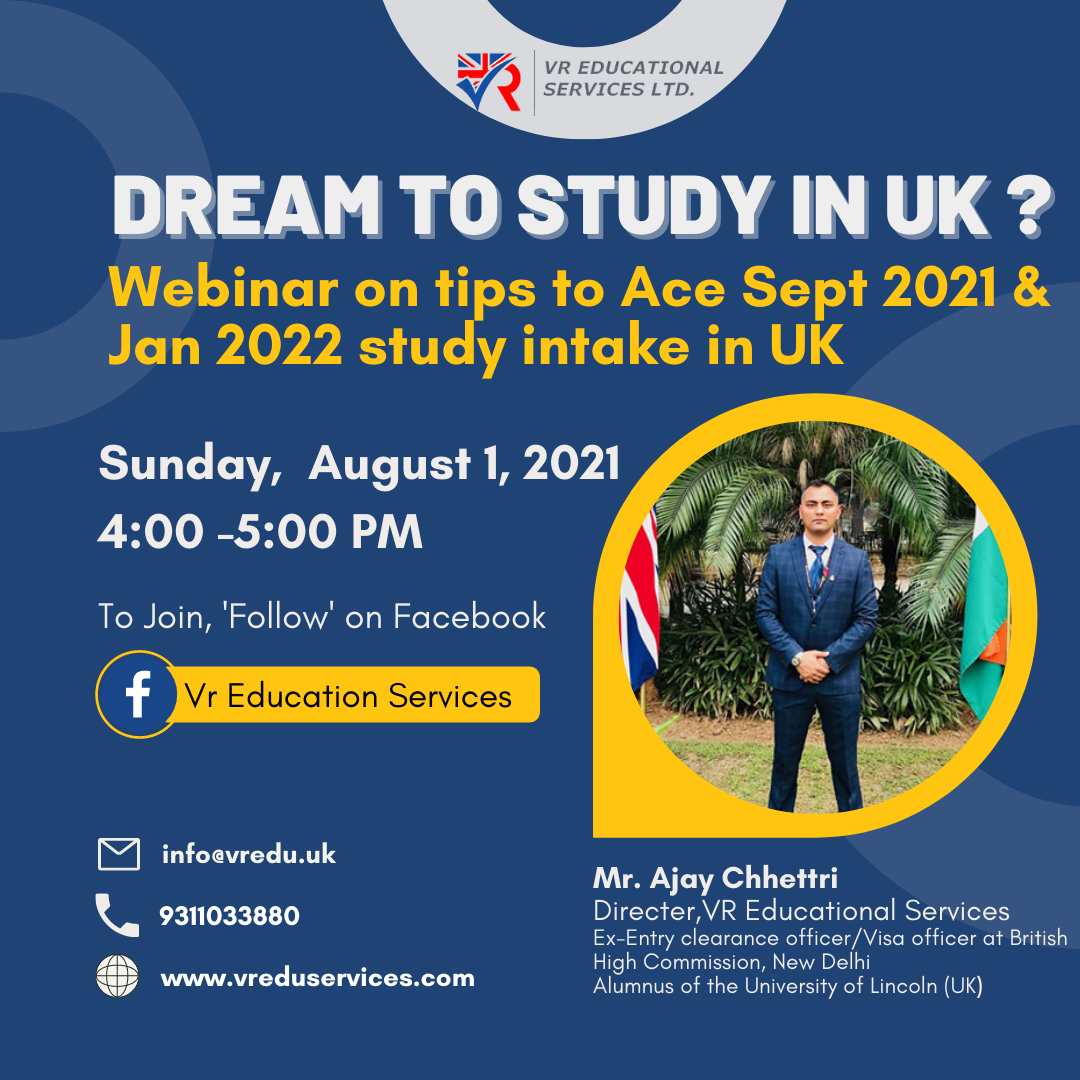
If you faced any difficulty in applying for UK September Intake 2021, VR educational Services Limited can assist you from choosing universities to final reaching out. Also, VR Education Services going to conduct a free webinar on Tips to Ace Sept 2021 and Jan 2022 UK study Intake on August 1, 2021.

VR Education Services | Study Abroad Consultants
Webinar On Tips to Ace Sept 2021 and Intake Jan 2022 UK study

Top 5 Benefits of Studying in Canada | VR Education Services

Benefits of studying in Canada |VR Education Services

From the last 8-9 years, Canada has steadily gained prominence as a preferred location for higher education. It is becoming one of the most popular destinations for Indian students seeking higher education. Canada has become the first choice of Indian students to study abroad as it is a suitable mix of high-quality education combined with internship possibilities, as well as flexible government laws on post-study work and immigration.

A decade ago, students from financially strong families were more likely to pursue an education abroad. For many, it was more than just an education; it was a prestige symbol. Canada has changed all of that since it provides the best of both worlds. They have institutions like the University of Toronto, the University of Alberta, and the University of British Columbia for students who wish to get into the best universities. Canada boasts the best community college system in the world for students looking for low-cost, short-term programmes to help them save money on living expenses.

5 Benefits of studying in Canada or why Canada has become a Hot spot for Students

Best in Class Academics

If you want to get a bachelor’s or master’s degree, you can choose from a variety of colleges depending on your qualifications. Choose from a variety of specialized diplomas, advanced diplomas, and post-graduate degrees at Canadian institutions if you’re seeking a faster and more relevant way to learn skills.

In terms of educational streams, Canadian colleges and universities offer a wide range of programmes from several fields. In Canada, you can discover an appropriate programme in engineering, IT, healthcare, agriculture, sports, management, accounting, economics, mining, petroleum, renewable energies, and any other field.

Skill Improvement

We can all agree that a world-class education entails more than just what we study in school. It’s also about how well we’ve prepared ourselves for the actual world. To combat this, Canada has a terrific system called cooperative work. Co-op is a programme that allows students to work in their field of study while they are still in school. As a result, an engineering student studies with a work opportunity.

This prepares pupils for the real world by exposing them to a work atmosphere, as well as instilling discipline. So, if a student enrolls in a four-year degree programme that includes co-op, they will be able to obtain 16 months of important Canadian work experience during their studies.

Earning while learning

In addition to co-op, students are permitted to work part-time on campus or off for roughly 20 hours each week. They can also apply for a post-study work permit for up to three years, depending on the length of the programme.

Economical

Tuition fees in Canada’s institutions are quite low when compared to universities in other popular study destinations. And, when you consider the return on investment and the fantastic job options, both part-time and full-time, it’s a very practical alternative for Indian students. Qualified students can also apply for a variety of scholarships to help pay for their education.

Quality of life – Safe and peaceful

Canada has been regarded as one of the safest countries in the world. You will have the same rights as any other Canadian student as an international student. The basic essentials of life, such as clean air, clean water, and reduced population/competition, a sense of space, and other aspects of life, such as access to world-class healthcare, solid education infrastructure, and so on, all contribute to the quality of life.

So, after knowing the 5 benefits of studying in Canada, you have decided to study in Canada too, then don’t wait, immediately call the best study abroad consultants, VR education services limited, for counseling and visa processing. VR Education service limited is dedicated and experienced professionals that can help you in reaching your goal of studying abroad.

VR Education Services
Study Abroad consultants | VR Education Services

Top 6 benefits of studying in UK (United Kingdom)

Benefits of studying in UK VR Education Services

Some of the world’s oldest universities and colleges are in the United Kingdom (UK), dating back to the 12th and 13th centuries. Education in the United Kingdom has become a model for other countries as a result of its long history. For Indian students, UK is one of the hot spots for study abroad programs.

Here are the top 6 reasons why Indian students want to study in the United Kingdom:

  1. Excellent Academics

The academic standards of UK universities are among the highest in the world. In fact, four of the top ten institutions in the world are from the United Kingdom, including Oxford and Cambridge University. When studying in the United Kingdom, you will discover that practical and utility-based knowledge is valued. This will allow you to develop critical thinking and analytical skills, as well as creative abilities, in your chosen field.

  1. High-Quality Education

The Quality Assurance Agency (QAA) is a non-profit organization in the United Kingdom that evaluates the educational standards of all universities and colleges in the country on a regular basis. It not only monitors their performance through audits and subject evaluations, but it also assists in identifying the finest educational approaches and provides feedback for improvement. The UK higher education financing authorities review these research procedures as well and publish their findings on a regular basis. This ensures that all students, regardless of their course of study, have access to the highest level of learning, research, and instruction and it helps students in choosing the best course of study in the UK.

  1. Courses with a shorter duration

The UK education system offers short courses, allowing a student to graduate sooner while maintaining high quality. While an undergraduate programme can be completed in three years, a graduate programme can be completed in just one year. This not only saves time but also saves money to spend on tuition and living expenses.

  1. Work while Studying

A student can work part-time for up to 20 hours per week during the tenure of course time to help pay the daily living expenses while also pursuing education. During the semester break, students can even work full-time. This will assist in both paying the fees and gaining industry experience.

  1. Students’ health benefits

In the UK, The National Health Service provides free medical treatment to international students. In a foreign country, if a student is getting medical health facilities and that is free, it is a great advantage.

  1. PSW: (Post-study visa with scholarship)

The UK Home Office has formally opened the new post-study work visa (Graduate route visa) for international students. This will officially allow Indian and other international students to stay in the UK for work after completing their study courses. This is an added advantage for international students to choose the UK as a study-abroad destination.

For any assistance, from applying to college to arrival in the UK, feel free to call VR education Services. VR education services limited is a renowned education abroad consultancy working for the last many years.

VR education services
Education Abroad consultants | VR Education services


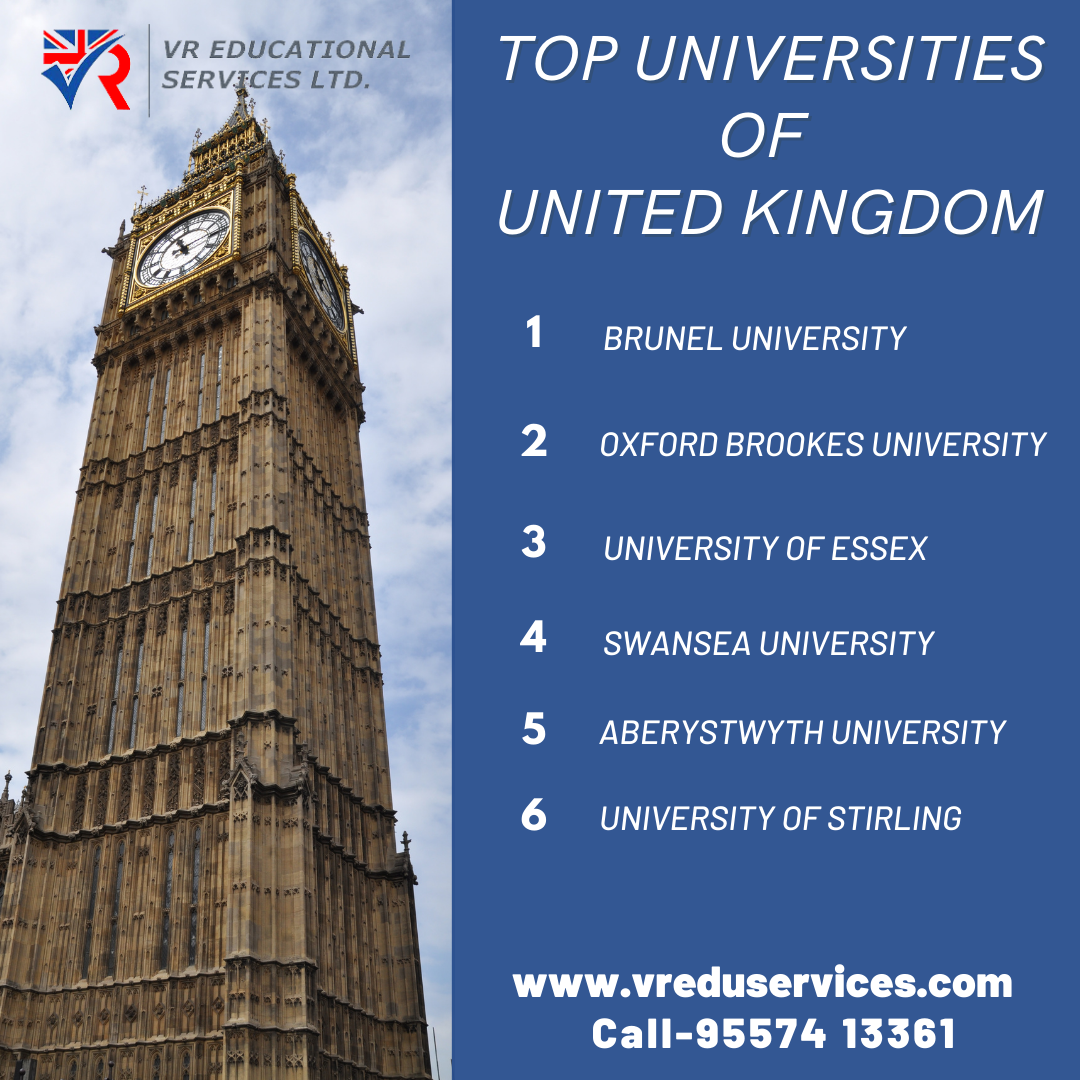
Universities to study in UK
Universities to study in UK | VR Education services

Frequently asked Questions for Study in Canada

Frequently asked questions for study in Canada

Canada is regarded as one of the top education destinations in the world, and it is seen as a gateway to a plethora of possibilities.

If you are planning to study in Canada, here are some frequently asked questions for your reference and help.

Q1.What is a study permit or student Visa?

It is a temporary immigration document issued by the federal government of Canada that allows foreign students to study in the country. If any student wants to study in a course in Canada that lasts longer than 6 months, he required to have a study permit. Also, study permits can only be issued to schools that are listed as Designated Learning Institutions (DLIs) by the Government of Canada.

Q2. How to apply for a Canadian Study Permit?

There are certain requirements that a foreign student needs to meet in order to apply for a Canadian study permit. Firstly, a student looking to study in Canada must have a letter of acceptance from the host school or college, he is interested to study in. After receiving the letter of acceptance, the student must apply online through the government of Canada website and meet the following requirements to complete the procedure:

  • Own a valid passport
  • Show that you have adequate financial funds in order to study in Canada, including school/ college fees, costs of living.

Q3. During studying in Canada, can students work part-time?

During studying in Canada, the student is permitted to work part-time. During the duration, of the course, students can work 20 hours per week. Moreover, during the course break, he can work full-time which is 40 hours per week.

Q4. Can an applicant Stay in Canada After his Study Permit Expires?

After completing the studies, a student has a 90 day grace period to either leave the country, extend the study permit, or apply for a different visa. Graduates can apply for a Post-Graduation Work Permit also.  This work permit visa allows international students to work anywhere in Canada in almost any field. After having Canadian work experience, the student can also extend their time in Canada by applying to become Canadian permanent residents.

Q5. Does an applicant need a study permit for each and every course in Canada?

A: A applicant does not need a Canadian study permit if he is taking a course that will last less than six months. It’s vital to remember this if a course lasts longer than six months, then the need of study permit is necessary.

Q6. Can applicants study free of Cost in Canada?

A: Most universities in Canada have awards that are offered to students based on their academic achievement. Indian students studying in Canada should be aware that there are unique awards available for them. Scholarships from the Canadian government are another key source of funding. Scholarships like the Ontario Graduate Scholarship Program, National Research Council of Canada (NRCC), etc.

If there are any more queries that you seek answers on studying in Canada, get in touch with VR Education services!

Study Abroad Consultancy
Study Abroad Consultancy | VR Education Services


Everything you need to know about SOP for Study Abroad

how to write a SOP for study Abroad | VR education services

A Statement of Purpose (SOP), also known as a letter of intent, is a document prepared for the admissions committee that discusses your career path, interests, professional accomplishments, ambitions, and motivation for pursuing a specific course. This is typically submitted as an essay, however, sometimes it is question-based also. It is the most crucial component for getting admission to foreign universities.

What is the purpose of an SOP?

SOP is the deciding factor in your application. It aids the admissions committee in determining your life goals, career objectives, aim, excellence, and vision. In short, a well-written SOP gives universities a picture of your overall personality. It’s your chance to tell the committee why you’re the best candidate for them and why they should pick you above the others as the admission committee has never seen you or they have never met you. That’s why SOP is regarded as “the” most crucial document.

Before writing any SOP, a candidate must know about some of the rules to obey while framing the SOP. These are:

  1. Your SOP language must be positive, precise, and free of grammatical errors.
  2. Emphasize characteristics that indicate your passion and objectives.
  3. Explain how your skills, hobbies, or experience will benefit the organization.
  4. Explain the purpose of taking a particular course at the institution.
  5. Validate your points with examples.

Visit VR Education Services for free counseling and also our experienced VR Education counselors can guide you in writing a great SOP to help secure your admission in the institution of your choice.

Steps to write down the SOP

Firstly, start describing your childhood interests in a short and how that interests are still in you.

Secondly, highlight your undergraduate percentage. While highlighting the percentage, do mention which subjects you have read in the undergrad and how those subjects inspired you to take the specific master’s course.

Further, explain the project or internship if you have done any and what you have learned from that, and how that experience can help you in the master’s course.

The next step is to write about the University. This is the most important part but be cautious, do not praise them irrelevantly. Express your liking of the university in terms of Research work, Labs, Faculty, and current projects.

Your information in this section must answer the questions like why you have decided to choose this particular university, why you have chosen this course, and what you think this university will help you in the future.

Last, conclude the SOP (in 2-3 lines) by saying that you will serve really well in the respective university and will bring a lot of value to the institution and your home country.

If you’re applying to a number of universities, then make sure your SOP  more or less remains the same except the paragraph where you describe the specific university.

Tip: You can take the help from VR Education Services Professionals for writing your SOP.

Points to avoid while writing SOP

  1. Don’t brag about your accomplishments and grades. Put it in a simple manner.
  2. Don’t Use slang while writing the SOP. Be professional.
  3. Your statement of purpose should not emphasize your desire to work for a foreign company or make a large sum of money. It should be geared toward your enthusiasm for the course and the university in question.
  4. Don’t make your SOP a long story, it can make readers go bored.
Study Abroad Consultants
Study Abroad Consultants | VR Education Services

Study Guide: Steps for International students to study in Canada | VR Educational Services

STUDY GUIDE to Canada | VR Education Services

If you’re planning to study abroad, Canada should be at the top of your list. It has
some of the best study programs in the world and is home to some of the best
research facilities and academic institutions in the world. Moreover, Canadian
universities have been doing consistently well in international rankings. In fact, in
one study in 2016, three Canadian Universities were ranked in the top 50
universities in the world.

There’s a wide array of Canadian institutions to choose
from, but whether you attend a university, college, or vocational school, there’s no
doubt that Canadian education is world-class.

Following is the step-by-step guide on how to apply to Canadian Universities :
1. Choose a Program:

Your program choice is one of the most important factors of your study permit
application. You must present a strong case for studying in Canada in this
particular program. VR Education makes program recommendations based on
your work experience and education history. This will give you the best possible
chance of submitting a successful application.

2. Apply to the School:
After deciding on a program, we will help you prepare and submit your
application. You need to have a Letter of Acceptance from a Canadian designated
learning institution (DLI) before you can apply for a study permit.

3. Apply for a Study Permit:
With your acceptance letter in hand, you’ll be ready to apply for your study
permit. VR Education will help you to prepare and submit your application to
Canadian immigration.. If your study permit is approved, come to Canada! You do
not receive your Canadian study permit until you arrive at a Canadian Port of
Entry (POE). If your permit is approved, the Canadian government will issue you a
Port of Entry Introduction Letter. You must show this letter to the immigration
official when you arrive in Canada to get your study permit.

International Student Document Checklist
Certain documents are necessary for the application process. Below is a list of
documents that may be requested of you.
Acceptance Letter: A letter sent by the school confirming your acceptance into
your program of study.
Proof of Financial Support: Proof that you have money to support yourself and
any family members coming with you. You must show that you can cover your
tuition fees as well as your cost of living (accommodation, food, etc.) for your first
year in Canada.
Identity documents: Birth certificate, marriage certificate, and passport.

How Long Does it Take to Apply for a Canadian Study Permit?
Processing times for study permits vary greatly. The amount of time it takes
depends on your country of residence.
The shortest processing time is 1-2 weeks, but some applicants can expect to wait
as long as 16 weeks. Processing times depend on the volume of applications
received. If you’re applying close to the beginning of Canada’s academic year you
may experience delays.

What Are the Conditions of a Canadian Study Permit?
There are certain terms and conditions attached to a Canadian study permit. You
must respect these conditions in order to retain all the benefits of your study
experience.
● You must be enrolled at a designated learning institution (DLI)
● You must be enrolled as a part-time student, or a full-time student if
studying in Quebec
● You must not take any authorized leaves longer than 150 days from your
program of study

How Much Does it Cost to Study in Canada?
The good news is that studying in Canada is affordable. Canadian tuition fees are
generally lower than those in Australia, the U.S., and the U.K.
In the 2018/2019 school year, the average annual tuition for an undergraduate
international student in Canada was $27,159 CAD. The average tuition for the
same year spent at an American university can be compared to $45,950 USD.
When deciding where to study abroad, the cost of living is also an important factor to
consider. The cost of living in Canada can be very affordable compared to most
other top destinations for international students.

Study Abroad Consultants | VR Education Services Limited

Student Guide To United Kingdom (UK) – Admissions, Requirements, Costs & Timeline

Study in UK & Canada | VR education Services

Admission Process Requirements

The requirements vary between study programs and levels. For each course, Indian students will need to meet a minimum English language requirement. Along with that a minimum academic record of 65% and above for humanities stream in class XII, and 70 – 80% and above for Science/Commerce stream in class XII will also be required. Foundations and Diploma programs are available for students who have secured below 60%. The student should have completed 18 years of age before joining a degree program.

It is important to note that these numbers are just for reference purpose, the actual numbers may differ from university to university.

The following documents also need to be submitted:

  • Attested copies of mark sheets of class X, XII, and the Bachelor’s degree (if applicable)
  • At least, two academic reference letters from professors who have taught you most recently.
  • If you have work experience then two Letters Of Recommendations from the employer/manager who knows you well and can comment on your professional abilities
  • Statement Of Purpose
  • Resume
  • Photocopied score reports of GMAT/IELTS/TOEFL
  • Portfolio (in case of students applying for art and design courses & Architecture programs)
  • Others (certificates/achievements at the state and national level and extracurricular activities)
  • Proof of funds


1. Tuition fee

Your expenditure on tuition fee depends on the type of qualification and university or school you opt for. There are many high-ranking universities and colleges in the UK with their own fee structures. Further, the fee also depends on where in the UK you choose to study (there are different rules for England, Scotland, Northern Ireland, and Wales), and your study level.

Most commonly humanities, arts, and education courses are cheaper, while subjects such as medicine and engineering are likely to be more expensive. If you wish to study at the postgraduate level, the tuition fees are typically higher and the costs vary depending on the program. As with most other countries, MBA programs are often the most expensive.

*Please note that:  all figures are indicative and PhD cost might differ as fully funded options are also available in the

Timeline

Here is a timeline to follow to get admission steps completed in time:

12-18 months before enrollment

  • Start researching and select 8-12 universities that you will apply to. Visit university websites and note application requirements, deadlines etc.
  • Learn about options to fund your studies.
  • Make custom application strategies for different universities.


10-12 months prior to enrolment

  • This is the time when you shift from the preparation mode to creating the application. Think hard about what makes you unique as an applicant and sketch out your strengths and self-assessment.
  • Register yourself and start preparing for required standardized tests like GMAT,GRE, IELTS – depending on the course and university.

10 months before enrolment

  • Begin by downloading admissions brochures from the university websites.
  • Start working on the UCAS admission form and application.
  • Search for and begin applying for external scholarships (if applicable).
  • Take standardized tests like GMAT and TOEFL.
  • Contact your professors and direct managers for at least two reference letters.
  • Begin drafting your SOP and essays.
  • Alongside your admission applications, plan for your expenses like applying for an education loan.

Enrolments

  • Apply before the deadline!
  • You may have to appear for a video interview in front of the admissions committee.
  • You will get your rejection letter via e-mail by April-June (the months may vary). The acceptance letter helps you attain student visa.
  • Gather paperwork for your student visa.
  • Depending on the deadline, you will need to notify the universities of your decision, pay a non-refundable deposit, and apply for your student visa.

Application fee: All colleges require that you pay an application fee while applying. The fee amount will differ depending upon the college and course being applied to, so check with individual colleges about their application fee.

SOP: A Statement Of Purpose  (SOP) is your introduction to the college and admission officers. It is always written in the first person and describes the reason for applying to a particular college. It needs to highlight why you are a perfect fit for the college and why the college should accept you. The style of writing could differ from formal to casual, but it is important to remember that it should reflect your personality as well.

Essay: Essays are also required to be submitted by a prospective student. Essays are an important part of the university admissions process. Students may be required to write one or two essays, along with a few optional essays too. Common topics include career aspirations, strengths and weaknesses, skills, experiences, and reasons for considering a particular school.

LOR: A Letter Of Recommendation  (LOR) is a reference letter written by a third party describing the qualities, characteristics, and capabilities of the prospective student to recommend him to the college in terms of that individual’s ability to perform a particular task or function. The third party could be a professor, direct manager etc.

UCAS

Applications to all undergraduate courses are filled through Universities and Colleges Admission System or UCAS – a central organization in the UK that is responsible for receiving undergraduate applications and forwarding them to the respective institutions.

UCAS allows you to apply to five Universities through a common form. £13 is the fees for one course or £24 for multiple courses and applications. The services offered by UCAS are designed for the admission to the September/October intake in the UK and you normally apply directly to a university for courses starting in January or February.

Note – Students seeking admission to a postgraduate program will have to apply to individual universities using the application form of that particular university. Most universities offer the facility to apply online for a nominal fee. Once the application form is filled appropriate supporting documents would have to be sent to the university. Although universities do not have a deadline it is recommended that you apply early to enhance your chances of being made an offer.

Intake seasons

The main intake seasons are September/October and January/February in the UK. The services offered by UCAS are designed for the admission to the September or October intake in the UK. You have to apply directly to a university for courses starting in January or February.

Entry Requirements

With 18 of its universities ranking in the global top 100 by the QS World University Rankings 2021, the UK is a popular destination among international students.. While the country offers a great cultural experience, international exposure and world-class degrees, you will need to take some standardised tests to fulfil your university application.

English language proficiency tests 

Given you are aiming to study in a country where English is a primary language, the first step is to appear for an English language proficiency test such as IELTS (International English Language Testing System).  Being the world’s most popular high-stakes English language proficiency test, IELTS is recognised by more than 10,000 organisations globally, including educational institutions, professional associations, employers, and governments of more than 140 countries.

For a successful application, you’ll require a minimum band of 6, while the top UK universities may ask for a band over 6.5, with no band less than 6 in all four modules. This requirement is subjective to the institution of your choice, so do check it properly beforehand.


Academic exams required to study in the UK

  1. For graduate business programs and other post-graduate courses:
  • GMAT (Graduate Management Admission Test): GMAT is accepted in most UK universities as it helps gauge the general knowledge of a student in respect to the subjects such as Algebra, Arithmetic, Geometry, Grammar, etc. It is a mandatory test for all graduate business programs
  • GRE (Graduate Record Examination): It’s a standardised test taken by applicants applying for a graduate degree program in the UK Universities.

IELTS: IELTS is designed to test the language ability of people who want to study or work where English is used as the language of communication. Over   3.5 million tests are taken each year.



UK Post Study Work (PSW) visa benefits to international students :

Study in UK & Canada | VR education Services

What is Post Study Work Visa?

Post Study Work Visa (PSW) is a Graduate Immigration Route type of UK visa that will allow international students who complete a degree at undergraduate level or above at a UK educational institute and who have a valid Tier 4 or Student visa at the time of application to remain in the UK and work.

What is Graduate Immigration Route ?

From 1 July 2021, international students who have successfully completed an undergraduate or master’s degree will be able to benefit from two years’ work experience in the UK upon graduation, through the new Graduate Route. Students who complete their PhD will be able to stay for three years.

Here is everything you need to know:

  • The Graduate Route will be available to international students who have a valid student visa at the time of application and have successfully completed a degree at undergraduate level or above at a Higher Education Provider with a track record of compliance.
  • Successful applicants on this route will be able to stay and work, or look for work, in the UK at any skill level for a maximum period of two years if they have successfully completed an undergraduate or master’s degree. PhD graduates will be able to stay for three years. Graduates will be able to switch into skilled work once they have found a suitable job.
  • The new route will be launched on 1 July 2021, meaning that any eligible student who graduates after this date will be able to apply for the route. This includes students who have already started their courses.
  • The Graduate Route will require a new visa application, which will only be possible from inside the UK.
  • It will include the payment of a visa fee of £700 and the Immigration Health Surcharge at the full rate of £624 per year.
  • Students will also need to know the Confirmation of Acceptance for Studies (CAS) they used for their most recent Student (or Tier 4) application in order to apply for the Graduate Route.

If you began your studies in the 2020-21 academic year, you will be able to benefit from this new route, even if you began your degree online in your home country due to Covid-19.

If you are due to complete your course in summer 2021 but have been unable to travel to the UK just yet, you will be eligible to apply for the Graduate Route, as long as you arrive in the UK before 21 June 2021 (this has been updated from the previous 6 April date).

If you started a one-year master’s course in January 2021, you will need to arrive in the UK by 27 September 2021 in order to be eligible to apply for the Graduate Route.

Key points of PSW visa

  • Interested students will need to make a separate application for this and pay application fees & Immigration Health Surcharge (IHS) fees.
  • This visa will allow students to work full time in most type of jobs, they will also be able to undertake self-employment professions.
  • There will be no requirement to secure any sort of sponsorship for those looking to apply for Post Study Work Visa.
  • The scheme will apply retrospectively even to those students who started their course prior to the scheme coming into effect, as long as the student is graduating in Summer 2021 or later.
  • It will not be possible to extend the Post Study Work visa: students will be expected to switch to a different immigration category including student route, or leave the UK.
  • Students will be able to apply for PSW visa only once i.e. they won’t be able to switch to Student visa from PSW visa, complete another degree and apply for PSW a second time.
  • Same policy will apply to students’ dependents and they will enjoy the same rights.

Benefits to international students of Post Study Work Visa

Rights of working full time and earn Return on Investment

The PSW work visa will allow eligible students to work, or look for work, at any skill level, for a period of two/three years after completion of their courses. They will be able to earn money and get the Return on Investment in higher education.

Opportunity to practice academic learning at workplace

The visa period will open a new window for students for applying their academic learning into practice at workplace, an opportunity to convert theoretical learning into practical tasks.

Opportunity to gain transferable skills

As graduates will have the opportunity to work with their chosen industries or sectors; they will gain transferable skills including analytical, effective communication, persuasive, teamwork, leadership, decision-making, organisation and planning, self-awareness and other soft-skills necessary to succeed.

Opportunity for networking with professionals

During the work period, forward-looking graduates may use the platform to network and connect with professionals from their chosen industries and expand their opportunity fields for future benefits.

Potential opportunity for Tier 2 work visa by employers

When working at company during the PSW visa, the employer company may offer Tier 2 Skilled visa if they of sponsoring right. Even graduates will be open to seek Tier 2 visa or other skilled job visa at other companies in the UK.

Flexibility to switch to student visa again or other types

At the end of PSW visa, graduates will be able to switch back to student visa or they will have the chance to switch to other visa types if they fulfil the eligibility criteria from inside the UK.

Great take-away to home country

UK degree and work experience will be great take-away for students who will return to home country where potential employers will be benefitted from graduates’ world-class knowledge and skills to leverage competitive advantage for them and for the country.

Post Study Work (PSW) work visa under the Graduate Immigration route will open may avenues for international students to the UK, a top higher education destination and lucrative commercial hub of the world. The scheme will benefit not only the students and their home countries, it will give many advantages to the UK employment sectors too. The UK Government warmly welcomes international students to grab the opportunity of this Graduate route.

For the latest updates, please visit :

https://www.gov.uk/government/organisations/uk-visas-and-immigration

ALL YOU NEED TO KNOW ABOUT CANADA – FAQ’s !

Study in UK & Canada | VR education Services

Moving to a new country is not a cakewalk. The lifestyle, classroom environment, transportation – everything is going to be different from India. And we know you have a lot of questions in your mind, so have answered common questions students like you raise about studying and living in Canada.

Here are some answers to help you know Canada better

Do Canadian institutions accept 10+2+3 education system of India?

Yes, 10+2+3 system is accepted for post graduate (PG) diploma programs. However, for masters, almost all universities require 10+2+4. However, certain universities may accept 10+2+3 for masters in selected programs on a case-to-case basis.Unlike India, Canada has two parallel education systems wherein colleges and universities are separate entities. Colleges offer PG diplomas and universities offer masters programs. Some universities may also offer PG diploma programs in selected courses.

Which subject to choose and where to study in Canada ?

Choosing a program and an institution solely depends on your interests, academic background, and budget. To decide where to study and what to pursue, you can start by creating a list of your interests and skills and spend some time reflecting upon it. Do your research to understand which skillset or interest has a good scope professionally. Narrow down your choices accordingly and search for relevant courses and institutions. You’ll also have to take intakes of your preferred courses into consideration, because not all universities or colleges offer programs in all three intakes.

You can book a free counselling session with our experienced counsellors who can advise you on course selection, application submission, and visa procedure..

Which English language tests are accepted by Canadian institutions?

The International English Language Testing System (IELTS) is the most preferred English language proficiency test accepted by almost all the institutions in Canada. However, globally, Canadian institutions are open to accepting other proficiency tests as well (do check the official website of your preferred institution for the same).

Can students work during studies in Canada?

Indian students are allowed to work for 20 hours per week during an ongoing session and full-time during vacations. You can also get up to three years of extension post completion of your studies depending on your program duration.

For a one-year program, you can acquire a work permit of one year while for programs with duration of 2-4 years, you can get a work permit of up to 3 years.

(Visa rules are subject to change, please check the official website for the same).

What are the accommodation options available in Canada?

As an Indian student, you can opt for on-campus residence facility or look for an off-campus accommodation. Most universities in Canada offer dormitories for students from other countries. Living as a resident on-campus is a very affordable option, however you need to apply for it separately, and well ahead in time to secure a slot for yourself.

If you are unable to find such accommodation or wish to stay alone, you can get a space for yourself on rent in shared apartments/condominium. Remember, the rentals will vary from city to city.

Is there any special requirement for under -18 students to study in Canada?

If you are under 18, you need to submit a custodian letter in your visa application along with the rest of your documents.We will help you with the same when you apply for your visa.

Canada bears a strong pride in its rich and bountiful resources and have deep-seated respect for the environment.